Showing posts with label etymology. Show all posts

Monday, August 21, 2017

Admittedly, how often are you making Bundt cakes?


It's time to sit down, be honest, and ask yourself: How often am I making Bundt cakes in my everyday life?

Probably not enough, which explains some of the general disappointment people feel around you. Now you can improve everyone's mood by borrowing baking pans of all sorts from the library of all places. Specifically, the Carnegie-Stout Public Library in Dubuque, Iowa.

Sure, Dubuque is a bit of a haul for most Americans to visit to borrow a pan, but it's worth it in the end once you realize Bundt cakes en masse are about to come out of your kitchen.

Carnegie-Stout Library Director Susan Henricks tells local TV station KCRG it's all about reaching out to locals. "We're trying to meet people where they're at. Getting them to come in and see what we are like," Hendricks said.

What they're like is deliciousness. Library Bundt cake deliciousness.


If you're wondering why I keep capitalizing the word "Bundt," it's because the word was trademarked by Nordic Ware in the 1950s. "Bundt" is just an Americanization of "bund," which etymologists aren't even sure is authentically German with regard to food, since "bund" largely refers to a federation or alliance. An alliance of deliciousness on our taste buds, perhaps.

Monday, August 7, 2017

Fashionable Words: Codger


[Sometimes words die out of fashion. But sometimes those words are good words, words with a certain appeal that can't be denied forever. Those words should be brought back into fashion, used frequently and used often. These are those words.]


Word:

codger


Definition:  noun

A typically elderly man who is eccentric or strange in a humorous way.


Origin:

Despite the old man angle, this has nothing to do with anyone named Roger or that delicious fish we all love, cod.


Not a codger cod, but a tasty cod.


The best words are the ones that confuse the experts in a variety of ways. The beauty of a word like codger is that it not only suggests eccentric behavior, but it's so eccentric as a word that dictionaries and etymologists are lost. Nothing like quality synergy, I tell ya!

Google will tell you codger is derogatory, an insult to elderly men said by some misanthropic millennial. Yet, Dictionary.com suggests codger is said with affection, like when you aww-shucks your old uncle Ken (a codger) at his surprise 90th birthday party. The Free Dictionary? It defines codger as both offensive and loving. Indeed, all dictionaries waffle between both extremes when offering a definition. Kindergartners at an ice cream stand are more decisive.


Kind of like the old man in 'Up' was a codger.


What experts agree on is that codger first came into use by the mid-1700s as an evolution of the obsolete word cadger. A cadger was someone who begged or was a peddler, based off the verb to cadge. It suggests a more romantic time for homelessness or being destitute, all while channeling the best of Charles Dickens before Dickens ever got around to making poverty look quaint. Oliver Twist? Totally grew up to be a codger.


Oliver Twist is a codger waitin' to happen!


As for cadge/cadger--etymologists have no idea where it came from. Some suggest the Middle English caggen, meaning "to tie," but how tying something came to mean begging is beyond understanding.

At least we can envision Granddad being eccentric like some pre-Victorian era beggar.


Most obscure UrbanDictionary.com definition of 'codger':
(verbatim)

3.)  Usually following the word "old"; 
a coffin dodger, an old person who moans about their arthritis. They have little hair on their head, but compensate by tufts sprouting from their ears and noses (male) chins and top lips (female). 
They dispise anything that anyone under 30 may do. 
Cant manage to drive more than 30mph, and only drive on Sundays.

Codgers only drive like this in shopping plaza parking lots.


Used in a sentence:

The flaky codger taught the kids in the alley how he used to play dice back in the day.


Why you should use 'codger' in your everyday life:

How often can you offend someone in a pleasant way?


Word Awesomeness Scale (1-to-5):

Two

After all, alluding that Gramps is also a beggar and/or a peddler is a bit low.


Tuesday, July 25, 2017

Fashionable Words: Donnybrook


When you go shirtless, you know it's getting serious.


[Sometimes words die out of fashion. But sometimes those words are good words, words with a certain appeal that can't be denied forever. Those words should be brought back into fashion, used frequently and used often. These are those words.]


Word:


donnybrook


Definition:  noun

A free-for-all, a melee, a brawl.


Origin:

Ireland has gotten by during its existence largely based on a handful of stereotypes that--to a degree--its citizenry generally accepts:
a.)  potatoes
b.)  Guinness
c.)  whiskey
d.)  shamrocks
e.)  fighting

No one can deny a quality potato-based meal, and the debate on alcohol begins and ends immediately with a simple "yes, please." Fighting, though, seems like a silly stereotype until you realize that donnybrook--which is about WWE-style fighting--has its origins in Ireland as well.

First and foremost, donnybrook the word comes from Donnybrook, a modern-day district of Dublin, no different than Harlem is a part of New York City. The district gets its name from the Irish language Domhnach Broc, meaning "The Church of Saint Broc." Little is known about Saint Broc except that she founded a convent or church in the early eighth century, a church/convent long lost. By the tenth century, Vikings were raiding Ireland and most likely sacked Saint Broc's creation. Today, only a cemetery in use from that time period remains.

Am I saying the word donnybrook somehow is connected to a saint? Yes...yes, I am.


Nowhere does it say you need a mustache to be involved in a donnybrook


In 1204, King John of England (better known as the king in the Robin Hood stories and brother of Richard the Lionhearted) granted the corporation of Dublin to hold an 8-day fair in the Donnybrook district. Within fifty years, it was lengthened to 15-days, and for the next 660+ years a fair was held in Donnybrook annually.


King John: Lover of fairs and creator of donnybrooks.


What started out as a peaceful, boring get together slowly built up over the decades. Fair-goers started drinking heavily. Small fights begot moderate fights begot sizable fights begot what became known as donnybrooks. Stunningly, large amounts of alcohol and personal quarrels led to massive brawls. I'm as stunned by this revelation as you.

Ireland embraced its stereotype of drinking and fighting, so much so that in a 1778 newspaper article one writer complained, "How irksome it was to friends of the industry and well-being of Society to hear that upwards of 50,000 persons visited the fair on the previous Sunday, and returned to the city like intoxicated savages." Someone sounds like a Negative Nancy.


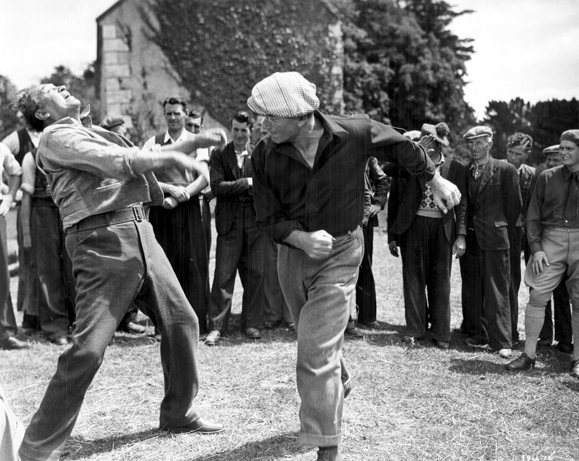
How most modern-day donnybrooks slowly start out, with John Wayne (right) throwing down.

Eventually, some in the community banded together to create a committee to end the fair. It took decades (the fair had a license, and whoever owned the license could end the annual get-together), but the committee eventually bought the license and ended the Donnybrook Fair in 1866.

The fair might have ended, but the association with chaos lived on, and so did the word.


Most obscure UrbanDictionary.com definition of 'donnybrook':

4.)  The word that gives the Irish and the college sports programs the Irish reputation for brawling [...] (and the) end of a donnybrook usually results in missing teeth, lacerations to the head, scars, scrapes, and bruises to the body. If you ever hear of a donnybrook starting at the place you're in, either run, or participate and be prepared for all of the above flesh wounds the next morning.


Used in a sentence:

After drinking two cases of beer while tailgating, Tommy and his friends started arguing with another group of fans, and everyone ended up in a donnybrook, throwing punches and kicks at each other in the parking lot.


Why you should use 'donnybrook' in your everyday life:

Using donnybrook is as close as your tender life will ever get to the world of MMA.


Word Awesomeness Scale (1-to5):

Three

It also sounds like it could be a name you randomly picked from a telephone book--like a guy named Donny Brook, who owns a butcher shop but does a little light illegal gambling on the side.


Friday, October 28, 2016

Fashionable Words: Cahoots


[Sometimes words die out of fashion. But sometimes those words are good words, words with a certain appeal that can't be denied forever. Those words should be brought back into fashion, used frequently and used often. These are those words.]


Word:

Cahoots


Definition:  verb / noun

1.)  go cahoots:  To share equally; become partners

2.)  in cahoots:  In partnership; in conspiracy with one another


Origin:

America likes to take delightful European things and bastardize them somehow, like Wonder Bread and microwaveable cheese product. This is why America can't have nice things.

Le sigh.

In the case of cahoots, the word first appeared in 1829. While the exact origin is unknown, the word was born as an Americanism of one of two similar--although much more debonair--French words cahute or cohorte.

Cahute is a 12th century French word that means a cabin or hut. (Think: Two people sharing a hut, possibly eating French bread and some aged Roquefort. And wine. Always wine.)

America is still trying to figure out how to bastardize Roquefort.

Some believe cahoots evolved from cohorte, the French word that also created the English cohort, meaning "companions." Except the modern English cohort has shady undertones in nefarious behavior. Indeed, you might be in cahoots with your cohort.

In turn, the French cohorte evolved from Latin. A cohort was one of ten divisions of a legion in the Roman army, usually made of 300 to 600 men. You definitely could not fit that many men in a cahute.

What I'm really trying to say is that Americans made up a word and no one has an idea how it came about--but let's assume it's fancy and French.

'Mericuh!


Most obscure UrbanDictionary.com definition of 'cahoots':

6.)  The sound an owl makes when it sneezes.

I beg to differ with the upstanding people at UrbanDictionary. Here's video of an owl who clearly needs some Allergra.


Not going to lie--I'm a little disappointed an owl sneeze sounds so dainty.


Used in a sentence:

"Sven and his cohort, Bjorn, were in cahoots to eat all the Cheez Whiz while the other campers slept in the cahute."


Why you should use 'cahoots' in your everyday life:

It's the illegitimate lovechild of a Parisian brasserie and an American dumpster fire.


Word Awesomeness Scale (1-to-5):

Four.

It loses a point for being the name of a British boy band.


Sunday, June 5, 2016

Fashionable Words: Malinger


[Sometimes words die out of fashion. But sometimes those words are good words, words with a certain appeal that can't be denied forever. Those words should be brought back into fashion, used frequently and used often. These are those words.]


Word:

Malinger


Definition:    verb

Exaggerate or feign illness, especially to avoid work.


Origin:

There's little the English and French agree on except drinking, fancy hats, and an unwavering passion for Gérard Depardieu. You can't find sexy, morbidly obese, sixty-something character actors just anywhere after all. Right, Gérard?


Damn right!

The English also love borrowing the occasional French word to use in their own vocabulary, such as malinger(er) or malingering. If there's anything the world can unite behind it's being a deadbeat.

The English malinger comes from the very similar French malingre, which means to be sickly. In turn, malingre has just evolved from the prefix mal- (bad) and Old French word heingre, which roughly means haggard. "Bad haggard"? That's right--loosely translated Old French can also sound like the worst name for a country music band.

Any thoughts, Gérard?


We all are shocked, Gérard.

Malinger first gained traction in the early 19th century, and then was quickly adopted by both psychologists (as a disorder) and the American military (for soldiers feigning illness), creating potentially the only time those two institutions shall ever be spoken of in the same sentence.

Indeed, malingering can lead to a court martial in the American armed forces. No coincidence then that the word spiked in its everyday common American usage around 1918, right as World War One raged. The word makes a second spike in use post-World War Two thirty years later.


No, Gérard, not everyone has your spitfire when it comes to war.

Today the word is used either in upper crust society parties, said with a jaw jutted out, or at your shrink's office to explain why you always have an excuse for skipping work because of that [[wink]] chronic bad back of yours.


Most obscure UrbanDictionary.com definition of malingerer:

[verbatim]
1.  A person who fakes an illness or injury to get out of work. Who is commonly know for screwing over his or her brothers so they have to work more overtime.


Sounds like a sibling rift somewhere, Gérard!


Used in a sentence:

Gérard was never called a malingerer with his strong work ethic!


Why you should use malingerer in your everyday life:

We all know that one person in our life who's a deadbeat and has an excuse for everything.


Word Awesomeness Scale (1-to5):

Five!

Calling a deadbeat a malingerer is like using an insult wrapped in satin.

Right, Gérard?


Sounds about right.


Friday, March 18, 2016

Fashionable Words: Ragamuffin


"I'm a--a--what?"


[Sometimes words die out of fashion. But sometimes those words are good words, words with a certain appeal that can't be denied forever. Those words should be brought back into fashion, used frequently and used often. These are those words.]


Word:

Ragamuffin


Definition:  noun

A ragged, disreputable person; often a child in dirty clothes and an unkempt state.


Origin:

Nothing pleases the British like making poverty sound quaint. Charles Dickens made a career off this model after all. And like most British words, ragamuffin is a child born of many parents.

There's no be-all origin story for ragamuffin. The first known use of it was in the Middle English epic poem Piers Plowman, not to be confused with modern English media personality Piers Morgan. Written in the 1300s about a character named Will who keeps falling asleep and having dreamvisions of spiritual meetings with religious figures, it's as exciting and titillating as you might imagine 14th century sleep to be. Ragamuffin makes its first known appearance in history as Ragamoffyn, a demon's name in the poem.

Morgan, not Plowman.


Wait--does this mean we actually have been calling Tiny Tim and Oliver Twist demons all this time? Yes. Yes, that's what I'm saying. We're all terrible people, you especially. I never claimed to like Dickens.

Most sources don't know what ragamuffin evolves from. The word probably comes from some variety of surname of the time, with "rag" being what you imagine--that thing you refuse to pick up to clean your bathroom. Even the famed English word master Samuel Johnson was uncommitted to the word's birth, actually stating in his famed dictionary, "From rag and I know not what else." In other words, he's got nothing. Thanks, Sam!


I got nothing for you.


"Muffin" probably just comes from a cute English wordplay, which is as cute as the Brits get, but some claim the word evolved from Middle Dutch's muffe, which means mitten, thus the clothing angle reinforced. Muffe would sound confusing these days after all, as we'd picture a fifty-something WASPy woman in jewels who is clearly no ragamuffin.

Shakespeare ends up using the word in 1597 in his play Henry IV (I'll save you the convoluted line), but it doesn't really gain traction in popularity until the 1800s. Writers like Louisa May Alcott, Anna Sewell, and Mark Twain all use it in their novels, and Charles Dickens pretty much creates the titular ideal of a ragamuffin in Oliver Twist. Google Books' Ngram Viewer even shows the spike in usage as the 19th century rolled on:

What does this all mean?

I don't know. Just that Oliver and Tiny Tim are demons.


Most obscure UrbanDictionary.com definition of ragamuffin:

12.  A person who does not like turnips or rutabagas.


Used in a sentence:

Part of me wondered if Oliver was angelic, but something suggested he was demonic, especially considering his filthy appearance as a ragamuffin from the streets.


Why you should use ragamuffin in your everyday life:

It subtly suggests delicious breakfast treats while reminding you you're too dirty, poor, and disheveled to afford delicious breakfast treats.


Word Awesomeness Scale (1-to-5):

Four.

It loses a point for being the name of a random cat breed and obscure Christian movie.


Monday, November 23, 2015

Is it stuffing? Or is it dressing?


Later this week Americans will gather with family and friends for a massive dinner most assuredly involving turkey. But what goes with the turkey, despite angry relatives, is a matter of where you live.

Is it stuffing or dressing?

Each word comes from a different etymological root, and Americans even disagree what each word defines. Butterball conducted a survey of 1,000 random people in nine different regions, finding that the majority of Americans call it stuffing. No region was more partial to calling it stuffing than New England, where 100% of respondents claimed it as such.

On the flip side, the East South Central Region (I don't know--ask Butterball where they got that name), which includes Kentucky, Tennessee, Alabama, and Mississippi, all favor dressing as the word of choice. In total, only 11 states have a dressing majority--while everywhere else favors stuffing.


In 2013, Epicurious did a peak season term search for both stuffing and dressing, and largely found the same result. The only major anomaly Epicurious and Butterball differ on is the state of Nevada, where Butterball claims they call it dressing. But Epicurious says that stuffing is the third-most searched for term in Nevada, well ahead of dressing--so what does Butterball know? In the end, does anyone trust a Thanksgiving dinner cooked in Nevada? No. No they do not.

There's an old adage that stuffing is what goes inside a bird and dressing is what's cooked alongside, but there's no validity to back up up those definitions. The famed cookbook The Joy of Cooking, published continually since 1931, once made such a claim, simply throwing out that interpretation without any facts as to origin. The book's huge popularity potentially influenced generations to come nonetheless.

So what is the etymoligical history of each word? Let's look at both:

Stuffing:
As might be obvious, stuffing was created out of the verb "to stuff," while adding the suffix "-ing." The modern version was spoken between the 15th and 16th centuries, depending on which dictionary you want to rely upon, but no later than roughly 1538, when it appeared in print. The Middle English stuff comes from the Old French estoffe (furniture or material) and estoffer (equip or furnish). In turn, the Old French comes from the Greek stuphein (draw together).

Except some etymologists disagree, claiming stuffing really was born out of the Latin farcire, Which became the French farcir (stuff), which became the English farce. Regardless, all agree stuffing became the norm by the 1500s.

Dressing:
Like stuffing, dressing is created out of the verb "to dress" with the added suffix of "-ing," but appeared earlier than its counterpart. The Middle English dressen was popular between 1275-1325, evolving out of the Anglo-French dresser or drescier. That came from the very similar Old French drecier, itself evolved out of the Latin dīrēctus--following somewhat the same root as the modern word direct.

Still awake? Boiled down, stuffing comes from Greek (unless it comes from Latin), dressing comes from Latin (but it's definitely not Greek).

When in doubt.
That doesn't quite explain the disparity in how geographically Americans gravitate toward one word over the other. One theory put forth argues that stuffing was widely accepted throughout England until the 1880s, when high-minded Victorian society found the word too crude, thus gravitating toward dressing instead. The theory continues that those who immigrated to America pre-1880 said stuffing (and thus passed it down), while those who crossed the Atlantic post-1880 influenced the regions with dressing.

Meanwhile, some cooks claim it's a matter of cornbread versus typical bread--with the dressing crowd using cornbread, and the stuffing masses using white bread.

Even historical food timelines seem at a loss as to how the schism in the word usage came about. The Oxford English Dictionary, which is usually reliable in such matters, describes dressing--with regard to food--as a stuffing.

In the end, the linguistic mystery of how a nation became divided really is a matter of what you choose to believe. Greek versus Latin, population ebbs and flows, cookbook influences--there's no concrete answer.

Whatever you want to believe, when it doubt, just call it Stove Top.


Wednesday, September 30, 2015

Fashionable Words: Chicanery


[Sometimes words die out of fashion. But sometimes those words are good words, words with a certain appeal that can't be denied forever. Those words should be brought back into fashion, used frequently and used often. These are those words.]


Word:
Chicanery

Definition:  noun
The use of trickery to gain a political, financial, or legal purpose.


Origin:
Chicanery's most immediate connection is the nearly identical French word chicanerie--because if the English can't learn to steal French cuisine, they might as well steal French words.

Things didn't evolve too quickly it seems, because if we go back further it appears chicanerie just came from the 16th century word chicaner, which meant "to quibble." That's right, we've gone 300+ years and the word has barely changed. And you thought service at a Parisian restaurant was slow.

From here is where things get murky, with dictionary after dictionary tossing out the always classic "origin unknown." But one etymological blog states that chicaner first appeared in a poem by François Villon (born in 1431), who was a medieval poet. If you're a bit rusty on your medieval poets, you get a pass on this one--but Villon led a life of crime and intrigue until he disappeared sometime around 1463.

Let's go to the highlights!

On June 5, 1455, Villon had a scuffle while in the company of a variety of other gentlemen, including a priest by the name of Philippe Chermoye. As if out of a stereotypical Hollywood adaptation, daggers were drawn, and while people were casually being stabbed in a delightful brouhaha (Chermoye is claimed to have drawn blood first), Villon apparently went big-time, stabbed Chermoye, then grabbed a stone and clobbered the priest over the head, who later died from his injury. Villon fled. A medieval version of a hit-and-run, if you will.


Let's pretend it looked something like this.


Villon was banished, but King Charles VII (best known as the king of France during Joan of Arc's hay day) pardoned him after receiving two petitions that said Chermoye forgave Villon before he died. Rii-i-i-ight. That might have been the head wound talking, but, hey, you take what you can get. As a result, Villon went back home to Paris.

Being the little rapscallion he was, Villon was allegedly involved in the theft of five hundred gold crowns from the chapel of the Collège de Navarre with a group of other thieves sometime around Christmas of 1456. Clearly a very merry Christmas for Villon. Months passed before the theft was discovered, and after one thief was arrested, he claimed Villon was the mastermind behind the crime. Villon was banished again, and apparently wandered for four years--with some scholars believing he led a gang of thieves during this time.

By 1461, Villon popped up again, this time writing that he had been in prison for the summer--which was practically a vacation by Villon's standards. A year later, in 1462, he was arrested again for theft. Villon enjoyed a little five finger discount with everything in life it seems. He made bail though--but then promptly found himself involved in a street fight and was arrested again. With this arrest, the old Christmas theft of five hundred gold crowns was brought up--and Villon was found guilty and ordered to hang. Yet, lucky as he was, he was pardoned by parliament and banished again on January 5, 1463.


Hey, baby Jesus wasn't using it.


And that's where Villon's story ends. He disappears from history. No trace exists as to what happened to him after that. Because I'm sure he went on to live a pious life and didn't have any enemies that would do him harm.


Most obscure UrbanDictionary.com definition of chicanery:
(verbatim)

2. it's a place where Chicanos (mexican-americans) go to school to learn trades.

(Ed.:  As if that doesn't sound a bit racist.)


Used in a sentence:

That shady gentleman used legal chicanery to be found not guilty in court.


Why you should use chicanery in your everyday life:

It sounds like it should be the name of some sort of candy--most likely a brand of licorice.


Word Awesomeness Scale (1-to-5):

Four

It gets a one point deduction for the whole murderer angle.


Wednesday, August 20, 2014

Fashionable Words: Flibbertigibbet


[Sometimes words die out of fashion. But sometimes those words are good words, words with a certain appeal that can't be denied forever. Those words should be brought back into fashion, used frequently and used often. These are those words.]


Word:
Flibbertigibbet


Definition:  noun
1.  A chattering or frivolous person, usually a flighty individual.

2.  The name of a devil or fiend.

3.  An individual of street urchin qualities, who looks mischievous or restless.


Origin:
No, strangely it has nothing to do with flubber.

As the OED tells us, flibbertigibbet seems to be an "onomatopoeic representation of unmeaning chatter." In other words, a nonsense word that now makes sense.

The first known use of flibbertigibbet occurred in 1549 by Hugh Latimer, the Anglican bishop who was later chaplain to King Edward VI, when he used the word in a sermon. Specifically, it appeared in the following tender-hearted gem, "These flatterers, and flybbergybes an other daye shall come & clawe you by the backe..."

Creating nonsense words while scaring the hell out of you--it's like my worst memories of Catholic school kindergarten.

Latimer in a rare moment not irking someone.
Latimer had the delightful tendency to annoy many people during his day though, and was all over the theological Christian map in the early 1500s when the schism between Roman Catholicism and Protestantism occurred. During his soap opera-esque life he...

...was born a Catholic...
...became a priest and self-declared himself as "obstinate a papist as any was in England"...
...changed his mind and realigned himself with Reformation doctrine by the mid-1520s...
...became the Bishop of Worcester in 1535 under Henry VIII...
...ticked off Henry for opposing the monarch's Six Articles, which mildly accepted some points of emphasis with Catholicism...
...was put in jail in the Tower of London...
...after Henry died, he got back in the good graces of Henry's son, Edward VI, becoming chaplain...
...and was then burned at the stake when the Catholic monarch, Mary I, took the throne after Edward.

But I think we all saw that coming.

As they say in St. Olaf, she's a flibbertigibbet.
Flibbertigibbet didn't gain much traction as a word for another fifty years, until the Archbishop of York, Samuel Harsnet, used the word in his treatise A Declaration of Popish Impostures in 1603, where he helps clarify devil names. "Frateretto, Fliberdigibbet, Hoberdidance, Tocobatto were foure deuils of the round, or Morrice," he wrote. Devil names have never seemed so exotic or flamboyant since.

Five years later, in 1608, Shakespeare jumped on the flibbertigibbet bandwagon, including the word in King Lear, specifically the line "The foule fiend fliberdegibek...hurts the poore creature of earth." Admittedly, not Shakespeare's most memorable stuff, but it helped legitimize flibbertigibbet.

Today, flibbertigibbet can best be described in the form of Rose Nylund from The Golden Girls.

Most obscure UrbanDictionary.com definitions of flibbertigibbet:
(all verbatim)

4.) a really long word

5.) like Lowtax but with whiter tetth

6.)  Some b**** with red hair. Word first used in the comedy "Joe VS The Volcano".

[Ed.: "Joe Versus the Volcano" was Tom Hanks' career low point.]


Used in a sentence:

That flibbertigibbet has spent the entire dinner party chattering about the most mundane things.


Why you should use flibbertigibbet in your everyday life:

Subtly evokes images of turkey giblets and the gallows.

Word Awesomeness Scale (1-to-5):

Four.

No word has ever sounded so insultingly cute.


Saturday, December 21, 2013

Fashionable Words--Special Holiday Word Edition: Humbug


[Sometimes words die out of fashion. But sometimes those words are good words, words with a certain appeal that can't be denied forever. Those words should be brought back into fashion, used frequently and used often. These are those words.]


Word:
Humbug


Definition:  
noun (and adjective)

A hoax; deceptive or false talk; a jesting or befooling trick; an imposition.

verb
To deceive; to trick.


Origin:

Yeah. No.

Humbug came into vogue around 1750, but beyond that--who knows?

No one knows. Not Merriam-Webster, not Reference, not the OED. When the OED gives up on you as a word, that's sad.

Wiktionary claims it comes from the combination of the slang for hum (to delude) and bug (a specter, a goblin). That sounds as good as any other rationale, except they don't back it up with any origination facts.

So let's all just give a hat-tip to good ol' Ebenezer and leave it at that.


Most obscure UrbanDictionary.com definitions of 'humbug':
(Everything verbatim)

4.  A humbug is a very rare insect that crawls up your butt when you sleep, and starts humming songs.

6.  A person that begs alot. They usually are cool so u let them in ur clique but u hate to be around them cuz they snakes they lie, sometimes are lame and they beg alot.

7.  What you get if you cross a Hummer with a VW.

11.  A sweet that all old people eat.

12.  A round black and white marbled inconsistancy in the otherwise yellow shit of a young baby and caused by previously taking a spoonful of gripe water.

13. The act of turning your dog upside down and licking it's testicles.

15.  an annoying person who loves to lick his toes.


Used in a holiday sentence:

Ghost of Christmas Past? Humbug!


Word Awesomeness Scale (1-to-5):

Four

It sounds pissy and crotchety. And pissy and crotchety is good at the holidays.


Wednesday, October 9, 2013

Fashionable Words: Rigmarole


[Sometimes words die out of fashion. But sometimes those words are good words, words with a certain appeal that can't be denied forever. Those words should be brought back into fashion, used frequently and used often. These are those words.]


Word:

Rigmarole (UK variant)
or
Rigamarole (US variant)


Definition:  noun and adjective
noun:
An overly involved piece of writing; an incoherent story.

adjective:
Overly protracted, elaborate, or diffuse; rambling.


Origin:
To detail the etymology of the British rigmarole, we're going to have to go through the usual rigmarole. Learning by doing--hooray!

So we head to the OED, experts in etymological rigmarole.

Rigmarole most likely comes from Ragman roll, which in turn is based off an old game called Ragman played in the 14th century. Ragman involved players grabbing on strings to pull out rolls which involved long, detailed descriptions of characters. And, yeah...that's about it. It's like competitive reading with a ball of yarn. You try keeping entertained in a time of plague.

King Edward I gets to hammerin'.


Yet, the proper noun Ragman potentially connects to the name of a statute of the same name by King Edward I in 1276, which provided for justices to be appointed to reform law and hear about local corruption the previous 25 years.

(In case you're trying to keep your medieval English monarchs straight, Edward I was also known as Longshanks and the Hammer of the Scots, a charming nickname that belies the fact the Scots defeated Edward's attempt to overtake them. Edward really should have been known as the Hammer of the Welsh. He conquered Wales by 1283.)


Samuel Pegge even loved
looking old.


Ragman
and Ragman's Roll's association with all things long-winded (like this etymology) slowly evolved into the modern rigmarole, which has its first known written appearance circa 1736 in Samuel Pegge's An Alphabet of Kenticisms. Pegge was an antiquary--a fashionable man of leisure and lover of old stuff--as well as a wannabe historian of language quirks in Derbyshire, England, which explains rigmarole's inclusion. Did he also hoard antiques and hold weekend yard sales? Sure, let's assume so.


Most obscure UrbanDictionary.com definitions of rigamarole:
1. An annoying series of seemingly unnecessary steps that causes a commotion and results in confusion, irritation and resentment by the people who inevitably have to do all the extra work to fix something they didn't break.

3.
Intense partying...
Perhaps involving cocaine, extasy, pcp, lots of booze, a joint or two, some lsd, mushrooms...etc.
Usually two/three day benders. The "rigamarole" intensifies as the party continues. Usually involves all the strange happenings as you continue to hallucinate and give 'er...


Used in a sentence:
1. Quit all this rigmarole and get to your point!


Why you should use rigmarole in your daily life:
It makes you sound like an 85-year old British grandmother, and who doesn't love 85-year old British grandmothers?


Word Awesomeness Scale (1-to-5):
Three.

Anything involving string could be slightly more exotic.


Thursday, December 20, 2012

Fashionable Words--Special Holiday Word Edition: Yule


[Sometimes words die out of fashion. But sometimes those words are good words, words with a certain appeal that can't be denied forever. Those words should be brought back into fashion, used frequently and used often. These are those words.]


Word:
Yule


Definition:
noun

Christmas, or the Christmas season.


Origin:

Merriam-Webster--those cherubs with their lackluster effort!--only tell us yule was first used sometime before the 12th century. That's like saying every word existed sometime before today. Safe guess.

Dictionary.com sees Merriam-Webster its 12th century prediction and raises it to the 10th century. They claim yule is born of the same parentage as the Old Norse word jōl.

The OED, the wise sages in all that is old and wordy, tells us that, indeed, yule came about in first known use in Old English style around the year 900--which is to say it looked nothing like it does today. It first appeared in the book Old English Martyrology (because nothing says the Christmas spirit like people being murdered!), specifically in this sentence:

Feowertig daga ær Criste acennisse, þæt is ær geolum.

I know. It looks like something J.R.R. Tolkien wrote while on a bender--but if you're reading this blog right now your ancient ancestors possibly once spoke a sentence very similar to the one above. In this case, the yule used in this Old English version is geolum.

By around 1440, yule started undergoing puberty. In Le Bone Florence of Rome, a medieval chivalric romance, yule appears in the following sentence:

Of seynt Hyllary the churche ys, The twenty day of yowle y wys.

Yule = yowle. We're getting closer.

By about 1500, in a version of the book Merlin, yule evolves again into the following:

The kynge is now deed sithe Martin-masse, and fro hens to yoole is but litill space.

That's damned near borderline Shakespearean, but I can already hear Engineering majors complain the sentence makes no sense still. Nonetheless, over the remaining centuries, yoole becomes yool becomes any variety of spellings, all until we get today's yule.


Most obscure UrbanDictionary.com definitions of 'yule':

1.  When some adolescent's voice breaks and it goes high pitched can be measured on a grade of 1 to 10.

3.  A move that Soulja Boy created that is displayed in his video where you put your arms straight out to one side and, with your hands in fists, move them up and down and hop the opposite way that your arms are pointing.

5.  To thrust hard during sexual intercourse.

6.  The act of [Ed.: Well, it's definitely sexual related, I'll say that much.]

7.  To thoroughly kick another person's ass or to beat another person indifinitely in a competition of wit and/or skill. This word can also be interchanged for the word shit. It is used negatively to show an opponent that he has been conquered.


Used in a holiday sentence:

1. Someone slice the yule log and let's get dessert rolling here!


Word Awesomness Scale (1 to 5):
Three.

Most dictionaries warn it might be confused with you'll. That's lame.