Showing posts with label Urban Dictionary. Show all posts

Monday, August 7, 2017

Fashionable Words: Codger


[Sometimes words die out of fashion. But sometimes those words are good words, words with a certain appeal that can't be denied forever. Those words should be brought back into fashion, used frequently and used often. These are those words.]


Word:

codger


Definition:  noun

A typically elderly man who is eccentric or strange in a humorous way.


Origin:

Despite the old man angle, this has nothing to do with anyone named Roger or that delicious fish we all love, cod.


Not a codger cod, but a tasty cod.


The best words are the ones that confuse the experts in a variety of ways. The beauty of a word like codger is that it not only suggests eccentric behavior, but it's so eccentric as a word that dictionaries and etymologists are lost. Nothing like quality synergy, I tell ya!

Google will tell you codger is derogatory, an insult to elderly men said by some misanthropic millennial. Yet, Dictionary.com suggests codger is said with affection, like when you aww-shucks your old uncle Ken (a codger) at his surprise 90th birthday party. The Free Dictionary? It defines codger as both offensive and loving. Indeed, all dictionaries waffle between both extremes when offering a definition. Kindergartners at an ice cream stand are more decisive.


Kind of like the old man in 'Up' was a codger.


What experts agree on is that codger first came into use by the mid-1700s as an evolution of the obsolete word cadger. A cadger was someone who begged or was a peddler, based off the verb to cadge. It suggests a more romantic time for homelessness or being destitute, all while channeling the best of Charles Dickens before Dickens ever got around to making poverty look quaint. Oliver Twist? Totally grew up to be a codger.


Oliver Twist is a codger waitin' to happen!


As for cadge/cadger--etymologists have no idea where it came from. Some suggest the Middle English caggen, meaning "to tie," but how tying something came to mean begging is beyond understanding.

At least we can envision Granddad being eccentric like some pre-Victorian era beggar.


Most obscure UrbanDictionary.com definition of 'codger':
(verbatim)

3.)  Usually following the word "old"; 
a coffin dodger, an old person who moans about their arthritis. They have little hair on their head, but compensate by tufts sprouting from their ears and noses (male) chins and top lips (female). 
They dispise anything that anyone under 30 may do. 
Cant manage to drive more than 30mph, and only drive on Sundays.

Codgers only drive like this in shopping plaza parking lots.


Used in a sentence:

The flaky codger taught the kids in the alley how he used to play dice back in the day.


Why you should use 'codger' in your everyday life:

How often can you offend someone in a pleasant way?


Word Awesomeness Scale (1-to-5):

Two

After all, alluding that Gramps is also a beggar and/or a peddler is a bit low.


Tuesday, July 25, 2017

Fashionable Words: Donnybrook


When you go shirtless, you know it's getting serious.


[Sometimes words die out of fashion. But sometimes those words are good words, words with a certain appeal that can't be denied forever. Those words should be brought back into fashion, used frequently and used often. These are those words.]


Word:


donnybrook


Definition:  noun

A free-for-all, a melee, a brawl.


Origin:

Ireland has gotten by during its existence largely based on a handful of stereotypes that--to a degree--its citizenry generally accepts:
a.)  potatoes
b.)  Guinness
c.)  whiskey
d.)  shamrocks
e.)  fighting

No one can deny a quality potato-based meal, and the debate on alcohol begins and ends immediately with a simple "yes, please." Fighting, though, seems like a silly stereotype until you realize that donnybrook--which is about WWE-style fighting--has its origins in Ireland as well.

First and foremost, donnybrook the word comes from Donnybrook, a modern-day district of Dublin, no different than Harlem is a part of New York City. The district gets its name from the Irish language Domhnach Broc, meaning "The Church of Saint Broc." Little is known about Saint Broc except that she founded a convent or church in the early eighth century, a church/convent long lost. By the tenth century, Vikings were raiding Ireland and most likely sacked Saint Broc's creation. Today, only a cemetery in use from that time period remains.

Am I saying the word donnybrook somehow is connected to a saint? Yes...yes, I am.


Nowhere does it say you need a mustache to be involved in a donnybrook


In 1204, King John of England (better known as the king in the Robin Hood stories and brother of Richard the Lionhearted) granted the corporation of Dublin to hold an 8-day fair in the Donnybrook district. Within fifty years, it was lengthened to 15-days, and for the next 660+ years a fair was held in Donnybrook annually.


King John: Lover of fairs and creator of donnybrooks.


What started out as a peaceful, boring get together slowly built up over the decades. Fair-goers started drinking heavily. Small fights begot moderate fights begot sizable fights begot what became known as donnybrooks. Stunningly, large amounts of alcohol and personal quarrels led to massive brawls. I'm as stunned by this revelation as you.

Ireland embraced its stereotype of drinking and fighting, so much so that in a 1778 newspaper article one writer complained, "How irksome it was to friends of the industry and well-being of Society to hear that upwards of 50,000 persons visited the fair on the previous Sunday, and returned to the city like intoxicated savages." Someone sounds like a Negative Nancy.


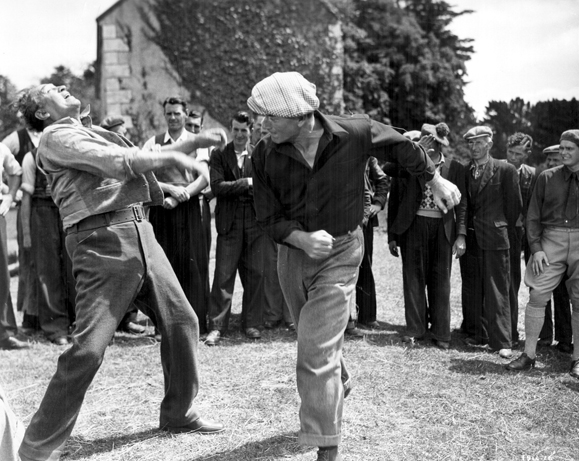
How most modern-day donnybrooks slowly start out, with John Wayne (right) throwing down.

Eventually, some in the community banded together to create a committee to end the fair. It took decades (the fair had a license, and whoever owned the license could end the annual get-together), but the committee eventually bought the license and ended the Donnybrook Fair in 1866.

The fair might have ended, but the association with chaos lived on, and so did the word.


Most obscure UrbanDictionary.com definition of 'donnybrook':

4.)  The word that gives the Irish and the college sports programs the Irish reputation for brawling [...] (and the) end of a donnybrook usually results in missing teeth, lacerations to the head, scars, scrapes, and bruises to the body. If you ever hear of a donnybrook starting at the place you're in, either run, or participate and be prepared for all of the above flesh wounds the next morning.


Used in a sentence:

After drinking two cases of beer while tailgating, Tommy and his friends started arguing with another group of fans, and everyone ended up in a donnybrook, throwing punches and kicks at each other in the parking lot.


Why you should use 'donnybrook' in your everyday life:

Using donnybrook is as close as your tender life will ever get to the world of MMA.


Word Awesomeness Scale (1-to5):

Three

It also sounds like it could be a name you randomly picked from a telephone book--like a guy named Donny Brook, who owns a butcher shop but does a little light illegal gambling on the side.


Friday, October 28, 2016

Fashionable Words: Cahoots


[Sometimes words die out of fashion. But sometimes those words are good words, words with a certain appeal that can't be denied forever. Those words should be brought back into fashion, used frequently and used often. These are those words.]


Word:

Cahoots


Definition:  verb / noun

1.)  go cahoots:  To share equally; become partners

2.)  in cahoots:  In partnership; in conspiracy with one another


Origin:

America likes to take delightful European things and bastardize them somehow, like Wonder Bread and microwaveable cheese product. This is why America can't have nice things.

Le sigh.

In the case of cahoots, the word first appeared in 1829. While the exact origin is unknown, the word was born as an Americanism of one of two similar--although much more debonair--French words cahute or cohorte.

Cahute is a 12th century French word that means a cabin or hut. (Think: Two people sharing a hut, possibly eating French bread and some aged Roquefort. And wine. Always wine.)

America is still trying to figure out how to bastardize Roquefort.

Some believe cahoots evolved from cohorte, the French word that also created the English cohort, meaning "companions." Except the modern English cohort has shady undertones in nefarious behavior. Indeed, you might be in cahoots with your cohort.

In turn, the French cohorte evolved from Latin. A cohort was one of ten divisions of a legion in the Roman army, usually made of 300 to 600 men. You definitely could not fit that many men in a cahute.

What I'm really trying to say is that Americans made up a word and no one has an idea how it came about--but let's assume it's fancy and French.

'Mericuh!


Most obscure UrbanDictionary.com definition of 'cahoots':

6.)  The sound an owl makes when it sneezes.

I beg to differ with the upstanding people at UrbanDictionary. Here's video of an owl who clearly needs some Allergra.


Not going to lie--I'm a little disappointed an owl sneeze sounds so dainty.


Used in a sentence:

"Sven and his cohort, Bjorn, were in cahoots to eat all the Cheez Whiz while the other campers slept in the cahute."


Why you should use 'cahoots' in your everyday life:

It's the illegitimate lovechild of a Parisian brasserie and an American dumpster fire.


Word Awesomeness Scale (1-to-5):

Four.

It loses a point for being the name of a British boy band.


Sunday, June 5, 2016

Fashionable Words: Malinger


[Sometimes words die out of fashion. But sometimes those words are good words, words with a certain appeal that can't be denied forever. Those words should be brought back into fashion, used frequently and used often. These are those words.]


Word:

Malinger


Definition:    verb

Exaggerate or feign illness, especially to avoid work.


Origin:

There's little the English and French agree on except drinking, fancy hats, and an unwavering passion for Gérard Depardieu. You can't find sexy, morbidly obese, sixty-something character actors just anywhere after all. Right, Gérard?


Damn right!

The English also love borrowing the occasional French word to use in their own vocabulary, such as malinger(er) or malingering. If there's anything the world can unite behind it's being a deadbeat.

The English malinger comes from the very similar French malingre, which means to be sickly. In turn, malingre has just evolved from the prefix mal- (bad) and Old French word heingre, which roughly means haggard. "Bad haggard"? That's right--loosely translated Old French can also sound like the worst name for a country music band.

Any thoughts, Gérard?


We all are shocked, Gérard.

Malinger first gained traction in the early 19th century, and then was quickly adopted by both psychologists (as a disorder) and the American military (for soldiers feigning illness), creating potentially the only time those two institutions shall ever be spoken of in the same sentence.

Indeed, malingering can lead to a court martial in the American armed forces. No coincidence then that the word spiked in its everyday common American usage around 1918, right as World War One raged. The word makes a second spike in use post-World War Two thirty years later.


No, Gérard, not everyone has your spitfire when it comes to war.

Today the word is used either in upper crust society parties, said with a jaw jutted out, or at your shrink's office to explain why you always have an excuse for skipping work because of that [[wink]] chronic bad back of yours.


Most obscure UrbanDictionary.com definition of malingerer:

[verbatim]
1.  A person who fakes an illness or injury to get out of work. Who is commonly know for screwing over his or her brothers so they have to work more overtime.


Sounds like a sibling rift somewhere, Gérard!


Used in a sentence:

Gérard was never called a malingerer with his strong work ethic!


Why you should use malingerer in your everyday life:

We all know that one person in our life who's a deadbeat and has an excuse for everything.


Word Awesomeness Scale (1-to5):

Five!

Calling a deadbeat a malingerer is like using an insult wrapped in satin.

Right, Gérard?


Sounds about right.


Wednesday, September 30, 2015

Fashionable Words: Chicanery


[Sometimes words die out of fashion. But sometimes those words are good words, words with a certain appeal that can't be denied forever. Those words should be brought back into fashion, used frequently and used often. These are those words.]


Word:
Chicanery

Definition:  noun
The use of trickery to gain a political, financial, or legal purpose.


Origin:
Chicanery's most immediate connection is the nearly identical French word chicanerie--because if the English can't learn to steal French cuisine, they might as well steal French words.

Things didn't evolve too quickly it seems, because if we go back further it appears chicanerie just came from the 16th century word chicaner, which meant "to quibble." That's right, we've gone 300+ years and the word has barely changed. And you thought service at a Parisian restaurant was slow.

From here is where things get murky, with dictionary after dictionary tossing out the always classic "origin unknown." But one etymological blog states that chicaner first appeared in a poem by François Villon (born in 1431), who was a medieval poet. If you're a bit rusty on your medieval poets, you get a pass on this one--but Villon led a life of crime and intrigue until he disappeared sometime around 1463.

Let's go to the highlights!

On June 5, 1455, Villon had a scuffle while in the company of a variety of other gentlemen, including a priest by the name of Philippe Chermoye. As if out of a stereotypical Hollywood adaptation, daggers were drawn, and while people were casually being stabbed in a delightful brouhaha (Chermoye is claimed to have drawn blood first), Villon apparently went big-time, stabbed Chermoye, then grabbed a stone and clobbered the priest over the head, who later died from his injury. Villon fled. A medieval version of a hit-and-run, if you will.


Let's pretend it looked something like this.


Villon was banished, but King Charles VII (best known as the king of France during Joan of Arc's hay day) pardoned him after receiving two petitions that said Chermoye forgave Villon before he died. Rii-i-i-ight. That might have been the head wound talking, but, hey, you take what you can get. As a result, Villon went back home to Paris.

Being the little rapscallion he was, Villon was allegedly involved in the theft of five hundred gold crowns from the chapel of the Collège de Navarre with a group of other thieves sometime around Christmas of 1456. Clearly a very merry Christmas for Villon. Months passed before the theft was discovered, and after one thief was arrested, he claimed Villon was the mastermind behind the crime. Villon was banished again, and apparently wandered for four years--with some scholars believing he led a gang of thieves during this time.

By 1461, Villon popped up again, this time writing that he had been in prison for the summer--which was practically a vacation by Villon's standards. A year later, in 1462, he was arrested again for theft. Villon enjoyed a little five finger discount with everything in life it seems. He made bail though--but then promptly found himself involved in a street fight and was arrested again. With this arrest, the old Christmas theft of five hundred gold crowns was brought up--and Villon was found guilty and ordered to hang. Yet, lucky as he was, he was pardoned by parliament and banished again on January 5, 1463.


Hey, baby Jesus wasn't using it.


And that's where Villon's story ends. He disappears from history. No trace exists as to what happened to him after that. Because I'm sure he went on to live a pious life and didn't have any enemies that would do him harm.


Most obscure UrbanDictionary.com definition of chicanery:
(verbatim)

2. it's a place where Chicanos (mexican-americans) go to school to learn trades.

(Ed.:  As if that doesn't sound a bit racist.)


Used in a sentence:

That shady gentleman used legal chicanery to be found not guilty in court.


Why you should use chicanery in your everyday life:

It sounds like it should be the name of some sort of candy--most likely a brand of licorice.


Word Awesomeness Scale (1-to-5):

Four

It gets a one point deduction for the whole murderer angle.


Wednesday, August 20, 2014

Fashionable Words: Flibbertigibbet


[Sometimes words die out of fashion. But sometimes those words are good words, words with a certain appeal that can't be denied forever. Those words should be brought back into fashion, used frequently and used often. These are those words.]


Word:
Flibbertigibbet


Definition:  noun
1.  A chattering or frivolous person, usually a flighty individual.

2.  The name of a devil or fiend.

3.  An individual of street urchin qualities, who looks mischievous or restless.


Origin:
No, strangely it has nothing to do with flubber.

As the OED tells us, flibbertigibbet seems to be an "onomatopoeic representation of unmeaning chatter." In other words, a nonsense word that now makes sense.

The first known use of flibbertigibbet occurred in 1549 by Hugh Latimer, the Anglican bishop who was later chaplain to King Edward VI, when he used the word in a sermon. Specifically, it appeared in the following tender-hearted gem, "These flatterers, and flybbergybes an other daye shall come & clawe you by the backe..."

Creating nonsense words while scaring the hell out of you--it's like my worst memories of Catholic school kindergarten.

Latimer in a rare moment not irking someone.
Latimer had the delightful tendency to annoy many people during his day though, and was all over the theological Christian map in the early 1500s when the schism between Roman Catholicism and Protestantism occurred. During his soap opera-esque life he...

...was born a Catholic...
...became a priest and self-declared himself as "obstinate a papist as any was in England"...
...changed his mind and realigned himself with Reformation doctrine by the mid-1520s...
...became the Bishop of Worcester in 1535 under Henry VIII...
...ticked off Henry for opposing the monarch's Six Articles, which mildly accepted some points of emphasis with Catholicism...
...was put in jail in the Tower of London...
...after Henry died, he got back in the good graces of Henry's son, Edward VI, becoming chaplain...
...and was then burned at the stake when the Catholic monarch, Mary I, took the throne after Edward.

But I think we all saw that coming.

As they say in St. Olaf, she's a flibbertigibbet.
Flibbertigibbet didn't gain much traction as a word for another fifty years, until the Archbishop of York, Samuel Harsnet, used the word in his treatise A Declaration of Popish Impostures in 1603, where he helps clarify devil names. "Frateretto, Fliberdigibbet, Hoberdidance, Tocobatto were foure deuils of the round, or Morrice," he wrote. Devil names have never seemed so exotic or flamboyant since.

Five years later, in 1608, Shakespeare jumped on the flibbertigibbet bandwagon, including the word in King Lear, specifically the line "The foule fiend fliberdegibek...hurts the poore creature of earth." Admittedly, not Shakespeare's most memorable stuff, but it helped legitimize flibbertigibbet.

Today, flibbertigibbet can best be described in the form of Rose Nylund from The Golden Girls.

Most obscure UrbanDictionary.com definitions of flibbertigibbet:
(all verbatim)

4.) a really long word

5.) like Lowtax but with whiter tetth

6.)  Some b**** with red hair. Word first used in the comedy "Joe VS The Volcano".

[Ed.: "Joe Versus the Volcano" was Tom Hanks' career low point.]


Used in a sentence:

That flibbertigibbet has spent the entire dinner party chattering about the most mundane things.


Why you should use flibbertigibbet in your everyday life:

Subtly evokes images of turkey giblets and the gallows.

Word Awesomeness Scale (1-to-5):

Four.

No word has ever sounded so insultingly cute.


Thursday, June 26, 2014

Fashionable Words: Doozy


[Sometimes words die out of fashion. But sometimes those words are good words, words with a certain appeal that can't be denied forever. Those words should be brought back into fashion, used frequently and used often. These are those words.]


Word:
Doozy


Definition:   noun (and adjective)
Something outstanding, remarkable, amazing, unique.


Origin:
Most likely a 20th-century creation, there's actually no concrete history as to where doozy comes from, although the OED suggests an old slang variant of the word daisy is the origin.

You're probably thinking flowers right now. Don't. Or maybe you're thinking of the female name, like Daisy Buchanan. Nah. While daisies are lovely flowers and Ms. Buchanan was a charming person when not mowing down innocent people in the road, the slang daisy didn't have to do with either flowers or female names. (Although Daisy Buchanan plowing over Myrtle in a speeding car was a bit of a doozy.)

The hydrangeaist!
Instead, daisy (as the classy doozy) meant something was first rate, top-notch, fantastic, etc., and first appeared in text in 1757. Its first appearance in something noteworthy came in 1886 when it popped up in the old children's novel Little Lord Fauntleroy, in the sentence "She's the daisiest gal I ever saw!" Admittedly, "She's the hydrangeaist girl I ever saw!" doesn't roll off the tongue quite as well.

Doozy
finally appeared in its own right in 1903, when it popped up in a book called Slang Fables from Afar by Al Kleberg. Kleberg, who is otherwise unnoteworthy, also holds the distinction of first citing batty (as in crazy) in a text.

Al Kleberg, the unknown Shakespeare of his time.


Most obscure UrbanDictionary.com definitions of doozy:
(verbatim)

4.  Something that is better than everything else. Also, a famous Runescape player who is one of the best in that game.

5.  A delicious drink in a can or bottle

The doozy card.


10.  someone that mean anything, a word that can be used anywhere at anytime, like how in uno you have a wild card that can be any color well DOOZY is a wild word it can mean anything.

11.  A night filled with excessive drinking to the point that events of the said night are hazy and cannot be completely recalled. There are varying degrees of "doozy", the most common being a night filled with drunken hilarity that for the most part is only recalled by those who did not get too drunk, or partake in the "doozy". A person who has a doozy usually wakes up the next morning wondering where he/she is, often times confused about the events of the night before.


Used in a sentence:


Better watch out--this snowstorm is going to be a doozy!


Why you should use doozy in your everyday life:

Makes you sound like an innocent seven-year old who just inherited an English estate.


Word Awesomeness Scale (1-to-5):

Three.

Could be mistaken as the name of Snow White's long lost dwarf.


Thursday, April 17, 2014

Fashionable Words: Tomfoolery


[Sometimes words die out of fashion. But sometimes those words are good words, words with a certain appeal that can't be denied forever. Those words should be brought back into fashion, used frequently and used often. These are those words.]


Word:
Tomfoolery


Definition:  noun
Foolish or silly behavior; the action or behavior of a tom-fool.


Waka-waka-waka!

Origin:

The modern tomfoolery has only been bandied about since 1812, when--according to the OED--writers (and brothers) Horatio and James Smith included the word in their book of humor, Rejected Addresses, specifically the line, "Round let us bound for this is Punch's holiday, Glory to Tomfoolery, huzza! huzza!"

Zing! That 19th century comedy is as fresh as ever!


Tomfoolery is just the offspring of a much older--and very similar--word, tom-fool (or, all dressed up like a proper noun, Tom-Fool), which the OED tells us was born around 1356. Joseph Thomas Fowler, in 1901, edited a manuscript from those quaint days of the 14th century called Extracts from the Account Rolls of the Abbey of Durham (your bible if you're an insomniac) which included the following sentence from 500+ years earlier, "Pro funeracione Thome Fole."


Note: Google Translate doesn't translate much.


[Side note: Google Translate detects that jambled sentence as Spanish. Or Latin. Or God knows what.

When translators quit on you, that's when you know you're diving deep.]


So why Tom and why fool?

For centuries Tom was considered a generic male's name, the same we might use the name John today. (Think: John Doe.) Tom Thumb, Tom, Dick, and Harry, tomcat, and Tom and Jerry are all examples of good ol' generic Tom. If you're named Tom, odds are your parents lacked imagination. This is how they met each other. They were dull. It happens.

As for fool, it appears as long as there has been language there have been fools. This results in a gasbag of an etymology, from Middle English to Old French to Italian to Latin, where we end up with follem or follish, which, when popularized in Latin, meant an empty-headed person.


Most Obscure UrbanDictionary.com definitions of tomfoolery:
(verbatim)

Trying to figure out what he needs to shine.
2.  Wreaking Havoc/causing general chaos/shennanigans, taking the piss, etc...

10.  Cockney rhyming slang for 'jewelry'. Often shortened to just 'tom'.

11.  monkey shines

12.  sticking a half-smoked joint into the carb of a pipe and covering the bowl with your thumb.


Used in a sentence:

1.  The administrators of the college won't stand for the hijinks and tomfoolery of the frats during pledge week.


Why you should use tomfoolery in your everyday life:
Because noahfoolery or jacobfoolery don't have quite the same ring.


Word Awesomeness Scale (1-to-5):
Two.

Shenanigans is better, but tomfoolery is reliable.


Saturday, December 21, 2013

Fashionable Words--Special Holiday Word Edition: Humbug


[Sometimes words die out of fashion. But sometimes those words are good words, words with a certain appeal that can't be denied forever. Those words should be brought back into fashion, used frequently and used often. These are those words.]


Word:
Humbug


Definition:  
noun (and adjective)

A hoax; deceptive or false talk; a jesting or befooling trick; an imposition.

verb
To deceive; to trick.


Origin:

Yeah. No.

Humbug came into vogue around 1750, but beyond that--who knows?

No one knows. Not Merriam-Webster, not Reference, not the OED. When the OED gives up on you as a word, that's sad.

Wiktionary claims it comes from the combination of the slang for hum (to delude) and bug (a specter, a goblin). That sounds as good as any other rationale, except they don't back it up with any origination facts.

So let's all just give a hat-tip to good ol' Ebenezer and leave it at that.


Most obscure UrbanDictionary.com definitions of 'humbug':
(Everything verbatim)

4.  A humbug is a very rare insect that crawls up your butt when you sleep, and starts humming songs.

6.  A person that begs alot. They usually are cool so u let them in ur clique but u hate to be around them cuz they snakes they lie, sometimes are lame and they beg alot.

7.  What you get if you cross a Hummer with a VW.

11.  A sweet that all old people eat.

12.  A round black and white marbled inconsistancy in the otherwise yellow shit of a young baby and caused by previously taking a spoonful of gripe water.

13. The act of turning your dog upside down and licking it's testicles.

15.  an annoying person who loves to lick his toes.


Used in a holiday sentence:

Ghost of Christmas Past? Humbug!


Word Awesomeness Scale (1-to-5):

Four

It sounds pissy and crotchety. And pissy and crotchety is good at the holidays.


Monday, November 25, 2013

Fashionable Words: Nincompoop


[Sometimes words die out of fashion. But sometimes those words are good words, words with a certain appeal that can't be denied forever. Those words should be brought back into fashion, used frequently and used often. These are those words.]

Word:
Nincompoop


Definition:  noun
A foolish person; an individual lacking common sense.

Origin:
No respectable dictionary will dare say with confidence. "Origin uncertain" is about as hard edge as they'll get.

Samuel Johnson--he being the grandaddy of all modern dictionaries--was throwing things against the wall and seeing what stuck when he wrote that nincompoop came from the Latin non compos, usually seen in legal terms like non compos mentis (not mentally competent).
Samuel Johnson double-checks his Latin.


Sounds legit, right? Not so, said the Oxford English Dictionary, as they picked a fight with a dead man and called out Johnson decades after his passing, suggesting his logic didn't account for variations of nincompoop that were around in the 1600 and 1700s. Today, the OED believes there's a chance nincompoop's origins come from the Dutch, especially the poop side of the word.

Poep, a 17th century Dutch derogatory word talking trash about Germans, was bandied about and adopted by English folk. Yes, poep gives us our modern use of poop. Today, whenever you casually mention the need to take a bowel movement, you're actually speaking ill of 17th century Germans. Remember that.

The nincom side of the word is equally obscure, with little proof of how it originates. The OED subtly suggests it might come from the French
nicodème (a simple person), which in turn comes from Nicodemite--a Middle French term that describes someone who is a timid adherent, especially religiously (think: Protestants in Catholic countries, or vice versa, 400 years ago), with allusions to the ancient gentleman named Nicodemus.

Why does the name Nicodemus sound familiar to you? No, he wasn't an early mathematician or third-rate mobster in a Martin Scorsese flick. In the bible, Nicodemus appears during the Gospel of John as a Jewish ruler who showed favor to Jesus Christ, most notably visiting Jesus at night to learn about his teachings. Later, after Christ's crucifixion, Nicodemus is mentioned as helping remove the body of Jesus from the cross.

That's right. Nincompoop somehow potentially combines Christ's crucifixion with the Dutch lingo for feces.

Most obscure UrbanDictionary.com definitions of nincompoop:


4. 
A braindead self important little turd given an impressive sounding job title to keep him blissfully ignorant of the world shattering nefarious machinations of his keepers. Derived from army slang 'non-com' short for non commissioned officer.

13. 
Slang term for anyone who is a devoted fan of Nine Inch Nails, or NIN, usually only used by other fans.


Used in a sentence:

1. That nincompoop used dirty dish water to fill up the coffee maker.


Why you should use nincompoop in your daily life:

It makes you sound like a nebbish academic, circa 1920.


Word Awesomeness Scale (1-to-5):
Four.

It's the only time you can say 'poop' without sounding like a kindergartener.


Wednesday, October 9, 2013

Fashionable Words: Rigmarole


[Sometimes words die out of fashion. But sometimes those words are good words, words with a certain appeal that can't be denied forever. Those words should be brought back into fashion, used frequently and used often. These are those words.]


Word:

Rigmarole (UK variant)
or
Rigamarole (US variant)


Definition:  noun and adjective
noun:
An overly involved piece of writing; an incoherent story.

adjective:
Overly protracted, elaborate, or diffuse; rambling.


Origin:
To detail the etymology of the British rigmarole, we're going to have to go through the usual rigmarole. Learning by doing--hooray!

So we head to the OED, experts in etymological rigmarole.

Rigmarole most likely comes from Ragman roll, which in turn is based off an old game called Ragman played in the 14th century. Ragman involved players grabbing on strings to pull out rolls which involved long, detailed descriptions of characters. And, yeah...that's about it. It's like competitive reading with a ball of yarn. You try keeping entertained in a time of plague.

King Edward I gets to hammerin'.


Yet, the proper noun Ragman potentially connects to the name of a statute of the same name by King Edward I in 1276, which provided for justices to be appointed to reform law and hear about local corruption the previous 25 years.

(In case you're trying to keep your medieval English monarchs straight, Edward I was also known as Longshanks and the Hammer of the Scots, a charming nickname that belies the fact the Scots defeated Edward's attempt to overtake them. Edward really should have been known as the Hammer of the Welsh. He conquered Wales by 1283.)


Samuel Pegge even loved
looking old.


Ragman
and Ragman's Roll's association with all things long-winded (like this etymology) slowly evolved into the modern rigmarole, which has its first known written appearance circa 1736 in Samuel Pegge's An Alphabet of Kenticisms. Pegge was an antiquary--a fashionable man of leisure and lover of old stuff--as well as a wannabe historian of language quirks in Derbyshire, England, which explains rigmarole's inclusion. Did he also hoard antiques and hold weekend yard sales? Sure, let's assume so.


Most obscure UrbanDictionary.com definitions of rigamarole:
1. An annoying series of seemingly unnecessary steps that causes a commotion and results in confusion, irritation and resentment by the people who inevitably have to do all the extra work to fix something they didn't break.

3.
Intense partying...
Perhaps involving cocaine, extasy, pcp, lots of booze, a joint or two, some lsd, mushrooms...etc.
Usually two/three day benders. The "rigamarole" intensifies as the party continues. Usually involves all the strange happenings as you continue to hallucinate and give 'er...


Used in a sentence:
1. Quit all this rigmarole and get to your point!


Why you should use rigmarole in your daily life:
It makes you sound like an 85-year old British grandmother, and who doesn't love 85-year old British grandmothers?


Word Awesomeness Scale (1-to-5):
Three.

Anything involving string could be slightly more exotic.